Cellular Automaton Simulator - Game of Life, ECA
Run Conway's Game of Life and all 256 Elementary Cellular Automaton rules in your browser. Set custom initial states and observe complex pattern generation.
What Are Cellular Automata?
Overview
Cellular automata (CA) are discrete computational models consisting of a grid of cells, each in one of a finite number of states. At each time step, every cell updates its state simultaneously based on a fixed rule that considers the states of its neighboring cells. Despite their simplicity, cellular automata can produce remarkably complex behaviors — from stable patterns to chaotic dynamics — making them a powerful tool for studying emergence and self-organization.
Brief History
Cellular automata were first studied by Stanislaw Ulam and John von Neumann in the 1940s at Los Alamos National Laboratory. Von Neumann was interested in self-replicating systems and designed a 2D CA capable of universal computation. In 1970, John Conway created the Game of Life, which became widely popular and demonstrated how complex behavior emerges from simple rules. In the 1980s, Stephen Wolfram systematically studied elementary cellular automata, classifying their behavior into four classes: Class 1 (uniform), Class 2 (periodic), Class 3 (chaotic/random), and Class 4 (complex/edge of chaos). He proposed that simple programs can generate complexity comparable to natural phenomena.
Types of Cellular Automata
Cellular automata come in many forms depending on their dimensionality, neighborhood definition, and rule structure. This site offers simulators for Conway's Game of Life (2D) and all 256 Elementary Cellular Automaton rules (1D).
| Type | Dimensions |
|---|---|
| Elementary CA | 1D |
| Totalistic CA | 1D / 2D |
| Life-like CA | 2D |
| Continuous CA | 2D+ |
Conway's Game of Life
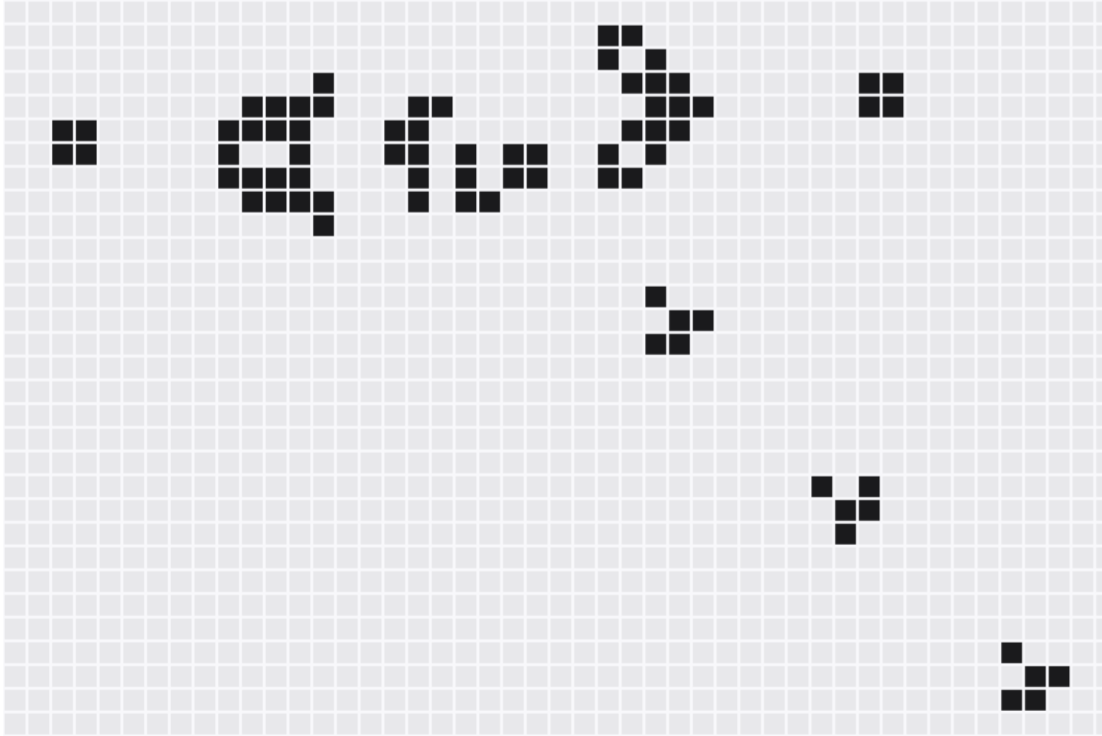
The Game of Life is a 2D cellular automaton created by mathematician John Horton Conway in 1970. It follows birth/survival rules (B3/S23): a dead cell with exactly 3 live neighbors is born, and a live cell with 2 or 3 live neighbors survives. From these simple rules emerge diverse patterns like gliders and pulsars, and the system has been proven Turing complete.
Elementary Cellular Automaton (ECA)
An elementary cellular automaton is the simplest type of CA, where each cell has two states (0/1) and its next state is determined by itself and its two neighbors (3 cells total). Since there are 8 possible combinations of 3 cells, exactly 256 rules (numbered 0–255) exist. They range from Rule 30, which produces chaotic patterns used in random number generation, to Rule 110, which is proven Turing complete.
Applications
- Modeling physical phenomena (crystal growth, fluid dynamics, diffusion)
- Biological simulations (population dynamics, pattern formation)
- Cryptography and random number generation (Rule 30)
- Traffic flow simulation and urban planning
- Theoretical computer science (computation universality, complexity theory)
FAQ
- Q: Are cellular automata Turing complete?
- A: Some are. Rule 110 in elementary cellular automata and Conway's Game of Life have been proven to be Turing complete, meaning they can simulate any computation that a Turing machine can perform.
- Q: What is the difference between Game of Life and Elementary CA?
- A: Game of Life operates on a 2D grid where each cell has 8 neighbors (Moore neighborhood) and uses birth/survival rules. Elementary CA operates on a 1D row where each cell has 2 neighbors, with 256 possible rule sets. Both are deterministic zero-player systems.
- Q: Who invented cellular automata?
- A: The concept was developed by Stanislaw Ulam and John von Neumann in the 1940s. Von Neumann designed a self-replicating CA as a theoretical model for biological reproduction. The field gained popular attention with Conway's Game of Life (1970) and Wolfram's systematic studies (1980s).
- Q: Can I use these simulators on mobile?
- A: Yes. Both the Game of Life and Elementary CA simulators run entirely in your browser and are responsive. Performance depends on your device, but modern smartphones handle them well.